

Think back to how you handled the web a couple of years ago versus how you handle it now. The page used to be the destination. Today it's raw material — something an assistant fetches, reads, and boils down while you wait for the answer. That shift sounds like pure progress, and in many ways it is. But progress this fast tends to leave a gap, and the gap here has a name worth learning before it costs you anything.
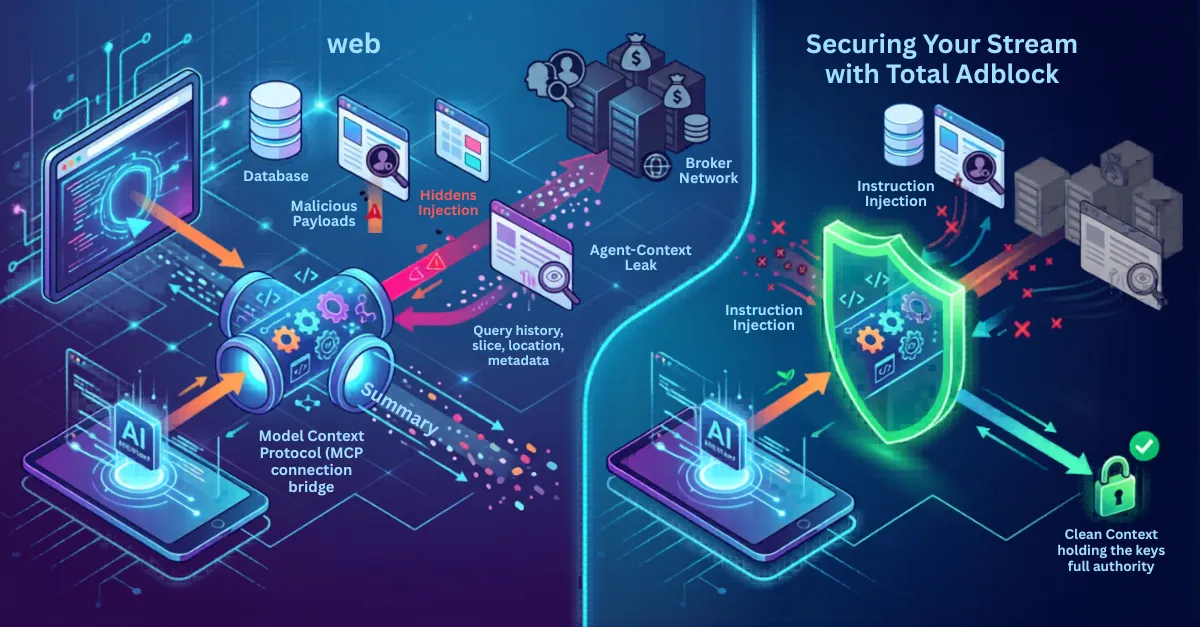
To make assistants genuinely capable, the industry settled on a shared way for them to reach the systems they need. The Model Context Protocol, or MCP, is an open standard that lets an AI application connect directly to websites, databases, and the apps on your own machine. It's the connective tissue of the agentic web — and like any standard that hands software broad reach, it's only as safe as the way it's wired up. Done carelessly, it opens a fresh vulnerability that the old privacy toolkit was never built to watch: the Agent-Context Leak.
The End of the "View-Only" Web
The web you grew up with was self-contained. You opened a page, your eyes did the reading, and you left. Whatever a site learned about you, it learned from your presence in that moment.
An agent changes the shape of that visit entirely. It goes to the page on your behalf and swallows the whole thing — the visible text, sure, but also the hidden metadata, the telemetry, the tracking signals woven into the markup. You get a clean summary; the agent quietly absorbed everything underneath it.
The catch sits one layer down. Assistants run on structured, high-quality inputs, and a lot of the suppliers racing to package that "agent-ready" data are the same advertising networks that powered the tracking boom of the early 2020s. The supply chain feeding your assistant didn't start fresh. In many cases it's the old machinery, retooled for a new customer that happens to be acting in your name.
Why Your Agent Is Being "Poisoned"
Brokers didn't fold when assistants arrived — they adapted. Selling your clicks was yesterday's model. Shaping data to flow cleanly into your assistant through an MCP connection is the new one. Three soft spots make that worth their effort.
Start with the consent paradox. The old consent model leaned on you seeing the choice — this site, this cookie, this banner. But MCP connections often run straight past traditional cookie prompts and consent management platforms, and they carry data your agent synthesizes rather than data you handed over. How do you knowingly agree to a conclusion an algorithm assembled from fragments you shared in separate places? You can't, really. The decision lands before any prompt could have caught it.
Then there are contextual leaks. When your assistant "personalizes" a summary, that personalization frequently means pushing your original query, slices of your history, and your location out to the AI provider — and often back to the site owner too. It's a steady drip of sensitive detail moving outward, wrapped in the language of helpfulness. A conventional ad blocker, scanning for familiar tracker domains, simply has no window into a leak that travels inside the agent's own workflow.
The sharpest risk is instruction injection. Attackers plant hidden directives inside ordinary-looking pages, written not for you but for the agent reading on your behalf. Through the MCP bridge, a page can attempt to coax your assistant into surrendering stored credentials, summarizing a private document it was never meant to open, or carrying out an action you never approved. An agent built to follow the instructions it encounters can't always separate your intent from a stranger's bait — and the protocol that gives it reach is exactly what makes a successful trick so consequential.
Shield your workflows against background instruction injection and context leaks.
Review AI-Agent Security OptionsThe Invisible Threat of "Shadow AI"
Running parallel to the technical problem is a governance one, and it comes down to who quietly holds your keys. Shadow AI is the spread of unsanctioned tools people pick up on their own — the assistant a coworker wires in without telling anyone, the personal automation you connect because it shaves twenty minutes off your morning.
Any single connection looks trivial. The exposure shows up when you add them together. Hook your calendar, your inbox, and your cloud drives into an unvetted assistant over MCP, and you've effectively handed a third party a master key to your identity — a party whose security practices you've never reviewed and likely can't evaluate. The convenience is immediate and obvious. The risk accrues quietly, far outside any data-governance plan that assumes you only touch approved software.
Reclaiming Your Digital Autonomy
The answer isn't a longer blocklist. It's a shift in how you regard the assistant itself. Treat it as a proxy that represents you, and hold it to the bar you'd set for any proxy acting in your name: vetted before you trust it, restricted in what it can reach, watched while it works. Three habits make that real.
Demand provenance. Lean toward tools and agents that can tell you where their information originated and how it was handled along the way. If an assistant can't trace the source of what it's feeding you, it can't reassure you the input wasn't shaped — or seeded — by someone with a motive. Knowing the origin is your first guard against acting on a poisoned one.
Practice ruthless data minimization. Before connecting any account, ask plainly: does this tool need my entire history, or just the narrow slice this one task demands? Default to the narrow answer every time. An assistant granted access to everything is an assistant capable of leaking everything; one scoped to a single job has far less to spill when something goes sideways.
Build in layered security. Provenance and minimization shape what the agent does with data. A protective layer in the browser shapes what reaches the page before the agent ever arrives — catching the tracking beacons and malicious scripts that try to prime your assistant with contaminated input. The earlier in the chain you cut the interference, the less your agent has to second-guess.
That browser layer is the part you can put in place today, without rebuilding how you work — and it's where a capable extension earns its keep.
Securing Your Stream with Total Adblock
As assistants quietly become your main doorway to the web, the Total Adblock browser extension does the unglamorous but genuinely useful work of cleaning the environment before you or your agent steps into it. The logic is plain: an agent can only ingest what a page actually serves, so a leaner, less hostile page hands it less to mishandle.
Where it focuses:
- Severing outbound connections. It cuts the tracking beacons that try to profile how your agent interacts with a page, denying broker infrastructure the contact it needs to fingerprint that exchange.
- Neutralizing malicious payloads. It blocks hidden scripts and seeded inputs designed to steer AI behavior through the MCP standard, removing a common delivery route for injected instructions before they ever load.
- Ensuring a clean context. By stripping intrusive ads and tracking clutter, it leaves your assistant closer to the core information it actually needs — which lowers the odds of stray data slipping out or the model behaving in ways you didn't intend.
Day to day, it runs quietly in the background. Intuitive presets let you tune the filtering to your own priorities, and you keep full authority over your own list of trusted sites and connections, so the pages you genuinely depend on keep working while known brokers stay shut out. Worth being straight about the limits: an extension can't supervise every decision an autonomous agent makes, and it won't single-handedly secure a poorly built MCP setup. What it can do is shrink your exposure and sanitize the surface your agent reads from — cutting how much tracking-laden or poisoned material reaches it in the first place.
The web is becoming something consumed on your behalf rather than viewed with your own eyes. Keeping the page clean before your stand-in ever touches it is how you stay the one holding the keys.
